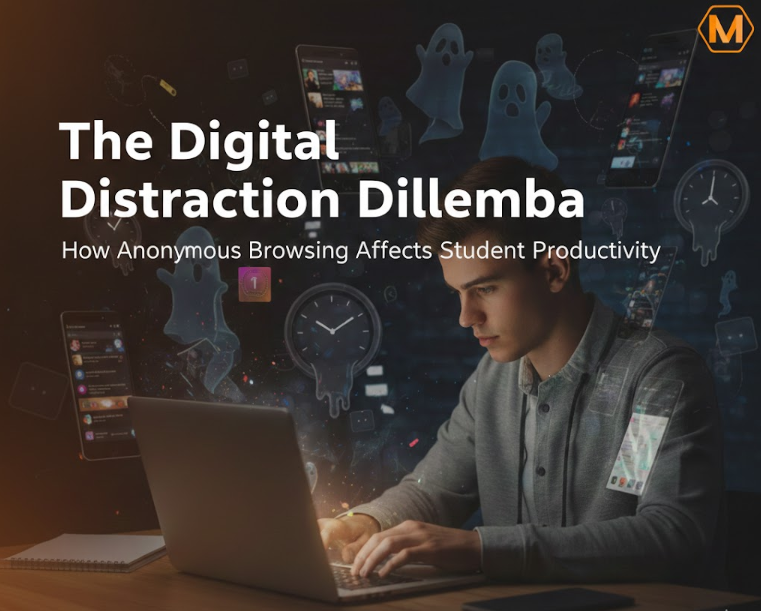
The Digital Distraction Dilemma: How Anonymous Browsing Affects Student Productivity
The modern college dorm room is a digital battlefield. On one side, there are heavy textbooks, open laptops with thirty tabs of research, and the looming shadow of a 3,000-word essay due at midnight. On the other side, there is the tiny, glowing rectangle of a smartphone. For most students today, the phone isn’t just winning; it’s staging a total takeover. We live in an era where digital distraction and student productivity are locked in a constant, exhausting tug-of-war. It isn’t just about checking basic notifications anymore; it’s about the incredibly deep rabbit holes we fall into. One of the most common, yet least discussed, distractions in 2026 is the rise of anonymous browsing tools. Whether it’s checking an ex’s stories without them knowing, keeping tabs on a rival’s “Studygram” lifestyle, or simply lurking in communities where you don’t want to leave a digital footprint, the lure of staying invisible online is consuming hours of valuable study time every single day.
This constant need to stay connected while remaining unseen creates a massive, silent psychological drain on the average learner. When you spend two hours cycling through anonymous browsing habits and viewing stories on platforms like IG Anony, your brain loses its fundamental ability to engage in “deep work.” This is a state of flow where real learning happens. By the time you realize the sun has gone down and you’ve achieved nothing, the “panic cycle” sets in. This is exactly why many students eventually reach a breaking point and realize they need professional Assignment Help from trusted platforms like myassignmenthelp, as it becomes the only viable way to salvage a grade after a whole day has been lost to the “scrolling void.” The impact of social media on academic performance isn’t always a slow, visible decline; sometimes, it’s a sudden, jarring realization that a major deadline is three hours away and your Word document is still a blinking white cursor on a blank screen.
The Hidden Psychology of the “Invisible” Scroller
Why is anonymous browsing so much more distracting than regular, logged-in social media use? The answer lies in the thrill of the “secret.” When students use specialized tools to view content without leaving a digital footprint, they feel a sense of detachment from their actual physical surroundings. It feels like a “free” activity with no consequences. This leads to a state of hyper-focus on the wrong things. Instead of concentrating on a complex biology lab report or a history thesis, the brain is fully occupied with the social dynamics of a digital world where they are essentially a ghost.
This behavior is a primary driver of procrastination in the digital age. It’s a low-stakes way to escape the high-stakes pressure of a university degree. However, the human brain doesn’t distinguish between “productive” stress and “social” stress. The cognitive load required to keep up with social trends—even when you are doing it anonymously—leaves very little mental energy for actual memorization or critical thinking. By the time you open your textbook, your “mental battery” is already at 10%, drained by the invisible labor of digital lurking.
The “Switching Cost” and the Death of Focus
Many students believe they are masters of multitasking. They think they can check an anonymous IG viewer for two minutes and then immediately go back to writing a high-level analysis of Shakespeare or Quantum Physics. Science tells a much darker story. Every time you switch your attention from a cognitively demanding task to a digital distraction, you pay what psychologists call a “switching cost.”

Research into focus and concentration for college students shows that it takes an average of 23 minutes and 15 seconds to fully regain deep focus after a single distraction. If you check an anonymous viewer or a social media feed every twenty minutes, you are effectively never working at your full intellectual capacity. Your brain remains in a constant state of “attention residue,” where part of your mind is still processing the last image or story you saw while you’re trying to decode a complex lecture. Over a four-year degree, this “residue” can lead to a significant drop in overall GPA and a lack of actual subject mastery.
Breaking the Cycle: Regaining Your Academic Edge
If you find yourself stuck in this loop of scrolling and regret, the first step isn’t to throw your phone out the window or delete the internet. It’s about building a more intentional relationship with your digital tools. Productivity isn’t about being a robot; it’s about setting hard boundaries that protect your future career.
Most successful students in 2026 have moved away from “total abstinence” and toward “strategic management.” They treat their attention like a bank account—they are very careful about where they spend it. When the workload becomes too heavy because you’ve spent too much time in the digital world, don’t let the quality of your education suffer permanently. If you find yourself overwhelmed with complex projects or missing pieces of your syllabus, seeking expert Coursework Help can provide the necessary breathing room to reset your habits and get back on track without failing your modules.
Practical Steps for Digital Detox:
- The 90-Minute Rule: Work in 90-minute blocks with your phone in a completely different room. Follow this with a 15-minute “scrolling break” as a reward.
- Browser Isolation: Never use the same browser for “fun” and “work.” Keep your academic work on a clean browser with no saved social media passwords.
- Grey-Scale Mode: Turn your phone screen to black and white. It makes the vibrant world of Instagram and anonymous viewing tools look boring, which reduces the dopamine hit your brain receives.
- The “Why” Check: Every time you open a tool to browse anonymously, ask yourself: “Does this help me graduate?” If the answer is no, put the device down.
The Rise of “Studygram” Culture and the Irony of Productivity
In a strange twist, many students spend their “study time” looking at other people studying. The “Studygram” or “StudyTok” communities are massive. Students use anonymous viewers to watch “Day in the Life” videos of Ivy League students, looking for inspiration. While this seems productive, it is actually a form of passive consumption.
Watching someone else highlight a book for three hours does not help you learn. In fact, it often leads to “imposter syndrome” and increased anxiety. You feel like you are working because you are looking at work-related content, but your brain is actually in a passive state. This is the ultimate digital distraction dilemma: using technology to watch people be productive instead of being productive yourself.
How Your Digital Footprint (and Lack Thereof) Affects Mental Health
Even though anonymous browsing tools allow you to hide your identity from others, you cannot hide it from yourself. There is a specific kind of “lurker’s anxiety” that develops when you spend too much time observing others without participating. It keeps your nervous system in a state of high alert. You aren’t relaxing; you are effectively “spying,” which creates a subtle layer of stress that contributes to academic burnout.
When burnout hits, it doesn’t just make you tired. It makes your writing become sluggish, your research become shallow, and your genuine interest in your chosen major disappear. This is where the distraction becomes dangerous. If a student loses their “spark” for learning because they are too caught up in the digital lives of others, the long-term cost is much higher than just a bad grade on one paper.
The Global Context: Why Students Everywhere are Struggling
This isn’t just an American or European problem. From London to Mumbai and Sydney to New York, the struggle with social media privacy tools and academic focus is a global phenomenon. Universities worldwide are reporting a decrease in the length of essays students are able to produce. The “attention economy” is global, and students are the primary target.
However, the students who will lead the industries of tomorrow are those who can navigate this environment. They are the ones who recognize when they are being manipulated by an algorithm and have the discipline to step back. They understand that while a tool like an anonymous viewer is a fun novelty, it shouldn’t be the thief of their degree.
Final Thoughts: Finding the Middle Ground
The goal of this discussion isn’t to demonize technology or suggest that you should never use an anonymous viewer again. We live in a connected world, and staying curious about social trends is a natural human instinct. However, when that “curiosity” begins to eat away at your semester goals, a serious change is required.
True student productivity in 2026 comes from knowing when to be “online” and when to be “in the zone.” It’s about recognizing that while your online presence can be anonymous, your academic transcript and your future career path are very much attached to your real name. You cannot “ghost” your way through a professional career.
If you have already fallen behind because of these distractions, do not panic. The worst thing you can do is give up. Use the resources available to you—whether that’s a campus tutor, a focused study group, or professional academic support—to catch up on what you’ve missed. Once you have cleared your backlog, make a firm plan to keep the “ghost browsing” for your commute or your weekend, and keep your study hours sacred. Your future self will thank you for the focus you find today.
Frequently Asked Question
1. How does lurking online impact my focus?
When you browse without interacting, your brain enters a passive state that diminishes critical thinking. This “observational mode” makes it harder to switch back to active tasks like writing or analysis, leading to a significant drop in mental energy.
2. Can I use social media during study breaks?
It is generally discouraged. Digital content triggers dopamine spikes that make academic work feel dull by comparison. For a more effective reset, try a “low-stimulation” break, such as stretching or a short walk, to allow your concentration to recover.
3. What is the “attention residue” effect?
This occurs when your thoughts remain stuck on a previous digital interaction while you are trying to focus on a new task. Even a quick glance at a social feed leaves a “residue” in your mind that can impair your cognitive performance for over twenty minutes.
4. How can I manage my time better if I am easily distracted?
The most effective method is “time-blocking.” By dedicating specific hours to deep work and keeping devices in a separate room, you remove the immediate temptation to browse, allowing your brain to enter a state of flow more easily.
About The Author
Alexander Andeerson is a dedicated education consultant and regular contributor at myassignmenthelp, where he explores the evolving intersection of digital habits and modern learning. He is passionate about helping students navigate the complexities of academic life in a hyper-connected world.