
Socialization MCAT: Complete 2026 Guide for High Scores
Preparing for the MCAT can feel stressful.
One key topic you must master is Socialization MCAT concepts.
The Psychological and Social Foundations section tests how society shapes behavior.
You must understand how people learn values, roles, and norms.
This guide explains socialization in simple English.
It follows 2026 MCAT standards and high-yield exam trends.
What Is Socialization MCAT?
In sociology, socialization means learning society’s rules.
For the socialization MCAT topic, it explains how behavior forms.
Socialization starts at birth and continues through life.
It shapes identity, beliefs, culture, and daily habits.
Medical schools test this idea because doctors treat diverse patients.
Understanding social influence improves cultural awareness and patient care.
Why Socialization Matters on the MCAT in 2026
The MCAT focuses on social determinants of health.
Socialization affects lifestyle, stress, and mental health.
In 2026, exam questions often link culture with health outcomes.
Students must connect behavior with environment and social structure.
For example, peer groups may influence smoking habits.
Family traditions may affect diet or exercise patterns.
The socialization MCAT concept helps explain these behaviors.
That is why it appears in many practice exams.
Types of Socialization on the MCAT
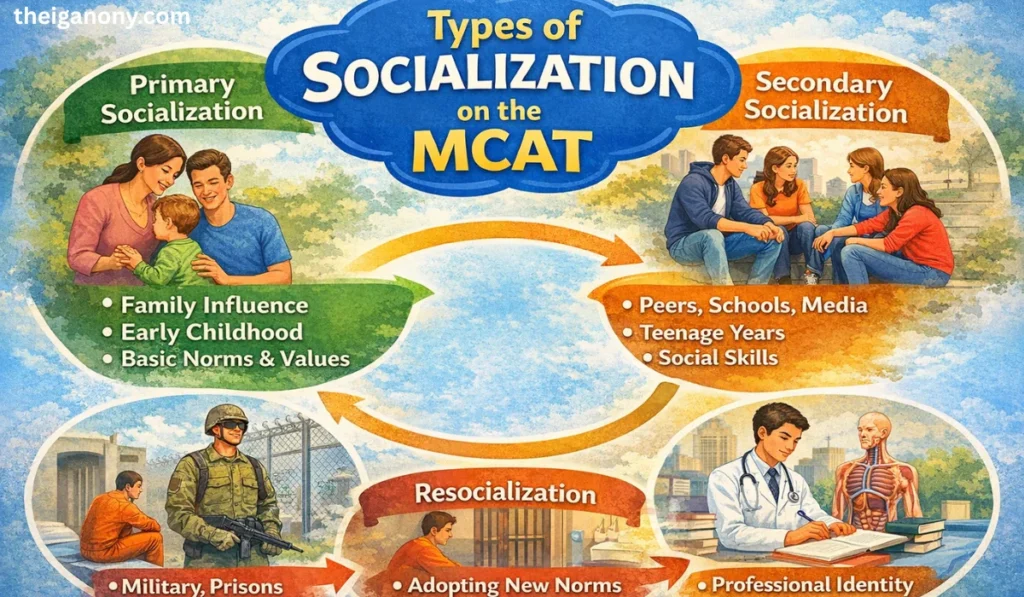
Socialization happens in stages.
Each stage shapes a person differently.
Primary Socialization
Primary socialization happens in childhood.
Parents and caregivers guide early learning.
Children learn language, manners, and beliefs.
This stage forms basic personality traits.
Secondary Socialization
Secondary socialization occurs later in life.
Schools, peers, and media play major roles.
Teenagers often copy their friends’ habits.
Adults learn new behaviors at work.
The socialization MCAT topic often compares these two stages.
You must know how they differ on exam day.
Read more: Association for social development
Agents of Socialization MCAT Students Must Know
Agents of socialization are groups that teach norms.
They shape behavior and values.
Below is a clear table for review.
| Agent | Role in Development | MCAT Example |
|---|---|---|
| Family | Teaches core values | Religious beliefs |
| School | Teaches discipline | Authority respect |
| Peers | Shape identity | Risk behavior |
| Media | Influences image | Body standards |
| Religion | Moral guidance | Ethical choices |
Examiners often link media exposure to behavior change.
Peer pressure questions are also very common.
The socialization MCAT section requires understanding these agents clearly.
Theories Behind Socialization MCAT
The MCAT tests sociological theories often.
You must connect theory with real-life behavior.
Social Learning Theory
Psychologist Albert Bandura developed this theory.
People learn by observing others.
Children copy actions they see rewarded.
Media violence may increase aggressive behavior.
This theory appears often in the socialization MCAT context.
Symbolic Interactionism
This theory focuses on meaning in interactions.
It explains how self-concept develops.
Charles Horton Cooley introduced the looking-glass self idea.
People shape identity based on others’ reactions.
Role Theory
Role theory explains behavior through social positions.
Each role carries expectations.
A doctor behaves professionally in hospitals.
A student behaves differently in class.
Understanding these theories improves exam accuracy.
Social Norms and Deviance
Norms are rules of behavior.
Society expects people to follow them.
There are two types of norms.
Folkways are minor customs, while mores are serious rules.
Breaking mores leads to strong punishment.
MCAT passages may link norms to deviance.
The socialization MCAT topic often tests how norms form.
Read more: Sociality house
Resocialization and Anticipatory Socialization
Resocialization means learning new norms.
It happens after major life changes.
Military training is a strong example.
Prison systems also change behavior deeply.
Anticipatory socialization prepares people for future roles.
Medical students act like future doctors.
These ideas appear in scenario-based questions.
Socialization and Identity Development
Identity forms through interaction.
Culture influences race, gender, and class identity.
Children learn gender roles early.
Society encourages certain behaviors for boys and girls.
Peer approval affects self-esteem strongly.
Media also shapes body image perception.
The socialization MCAT concept helps explain identity shifts.
Socialization and Health Outcomes
Socialization influences health behavior.
It affects diet, exercise, and substance use.
Family habits shape eating patterns.
Peer groups may influence drinking behavior.
Doctors must understand social background factors.
Cultural sensitivity improves patient communication.
MCAT examiners test social determinants often.
You must connect culture with health patterns.
Socialization Across the Life Course
People change over time.
Different life stages involve different influences.
| Life Stage | Main Influence | Example |
|---|---|---|
| Childhood | Family | Moral learning |
| Adolescence | Peers | Risk behavior |
| Adulthood | Workplace | Professional norms |
| Old Age | Community | Role transition |
Understanding lifespan development strengthens your score.
High-Yield MCAT Practice Focus Areas
The MCAT rarely asks simple definitions.
It presents long passages instead.
You must identify which agent influences behavior.
You must match theory to scenario.
If a child copies TV violence, think Bandura.
If a teen follows friends, think peer socialization.
Strong reasoning skills improve results.
2026 MCAT Trends in Socialization Questions
Recent practice exams show pattern shifts.
Questions now connect socialization with inequality.
Students must understand socioeconomic effects.
Lower income groups face higher stress exposure.
Cultural norms may affect mental health stigma.
Healthcare access often links to community norms.
The socialization MCAT topic now includes diversity awareness.
Medical schools value empathy and social insight.
| Concept | Key Idea | Why It Matters |
|---|---|---|
| Primary Socialization | Early childhood learning | Builds personality |
| Secondary Socialization | Later life learning | Shapes identity |
| Social Learning Theory | Behavior through observation | Explains imitation |
| Role Theory | Behavior based on position | Predicts actions |
| Resocialization | Learning new norms | Explains change |
This table helps during final revision.
Common Mistakes Students Make
Some students confuse culture with socialization.
Culture is shared beliefs, while socialization teaches them.
Others ignore theoretical frameworks.
The MCAT always tests theory application.
Memorizing alone is not enough.
You must understand cause and effect relationships.
Frequently Asked Questions
What does socialization mean on the MCAT?
It means learning social norms and behaviors.
It explains how society shapes individuals.
Why is socialization MCAT important?
It connects culture to health and behavior.
Medical schools value this understanding.
Is social learning theory tested often?
Yes, it appears frequently in passages.
Bandura’s model is high-yield content.
How can I master socialization MCAT quickly?
Review theories daily and practice passage questions.
Focus on application, not memorization.
Conclusion
The socialization MCAT topic plays a major role in 2026 exams.
It connects psychology, sociology, and medicine together.
Mastering socialization improves both score and future practice.
Strong understanding builds cultural awareness in healthcare.
If you study these concepts carefully, success will follow.