A Thing of Beauty: Meaning, Origin, Poem, and Modern Importance
A Thing of Beauty is a phrase that still feels fresh in 2026.
People use it for art, nature, kind acts, design, and peaceful moments.
The phrase became famous because of the English poet John Keats.
He used it in his long poem Endymion, which came out in 1818.
Today, readers still love this phrase because it carries a deep idea.
It tells us that true beauty gives joy, peace, and hope for a long time.
What Does A Thing of Beauty Mean?
A thing of beauty means something that gives lasting joy.
It may be a flower, a poem, a kind smile, or a calm place.
The phrase does not only talk about outer beauty.
It also shows inner peace, goodness, love, and comfort.
For example, a garden can be beautiful because of its colors.
A helpful person can also feel beautiful because of their kind heart.
In simple words, beauty can heal the mind.
It can lift sadness and make life feel softer.
Origin of the Phrase
The phrase comes from John Keats’s poem Endymion.
The poem starts with the famous line, “A thing of beauty is a joy for ever.”
Keats wrote during the Romantic period of English literature.
Romantic poets loved nature, feelings, dreams, and imagination.
Keats believed beauty had great power.
He felt beauty could help people face pain, fear, and dark days.
His words became famous because they sound simple but feel deep.
Even after more than 200 years, people still quote this line.
| Topic | Details |
|---|---|
| Main phrase | A thing of beauty |
| Famous writer | John Keats |
| Source poem | Endymion |
| Published year | 1818 |
| Main idea | Beauty gives lasting joy |
| Literary period | Romantic poetry |
| 2026 use | Poetry, quotes, captions, essays, and speeches |
Who Was John Keats?
John Keats was a famous English poet.
He was born in London on October 31, 1795.
He became one of the best-known Romantic poets.
His poems often show nature, love, death, art, and beauty.
Keats did not live a long life.
He died in Rome on February 23, 1821, at the age of 25.
Even with a short life, he left a strong mark on literature.
Many students, writers, and readers still study his work today.
Early Life of John Keats
John Keats grew up in London.
His father worked at a stable, and his family lived a modest life.
Keats faced loss at a young age.
His father died when Keats was a child, and his mother died later.
These sad events shaped his feelings and writing.
He learned early that life can be short and painful.
Still, he found comfort in books and imagination.
This love of beauty became a key part of his poetry.
Read more: Villas at stone oak ranch
Education and Learning
Keats studied at Enfield School.
There, he developed a strong love for reading and writing.
At first, he trained in medicine.
He worked as an apprentice and later studied at Guy’s Hospital.
But poetry pulled him more strongly than medicine.
He chose writing because it gave voice to his heart.
This choice changed English literature.
His poems became a lasting gift to readers across the world.
Why Beauty Matters in the Poem
In Endymion, beauty gives comfort to the human spirit.
Keats shows beauty as a force that can fight sadness.
He writes about nature, dreams, flowers, sleep, and peace.
These images help readers feel calm and hopeful.
The phrase a thing of beauty tells us that beauty does not fade fast.
Its joy can grow in the mind over time.
A lovely memory can return again and again.
That is why beauty can become a quiet shelter for the heart.
Main Themes in A Thing of Beauty
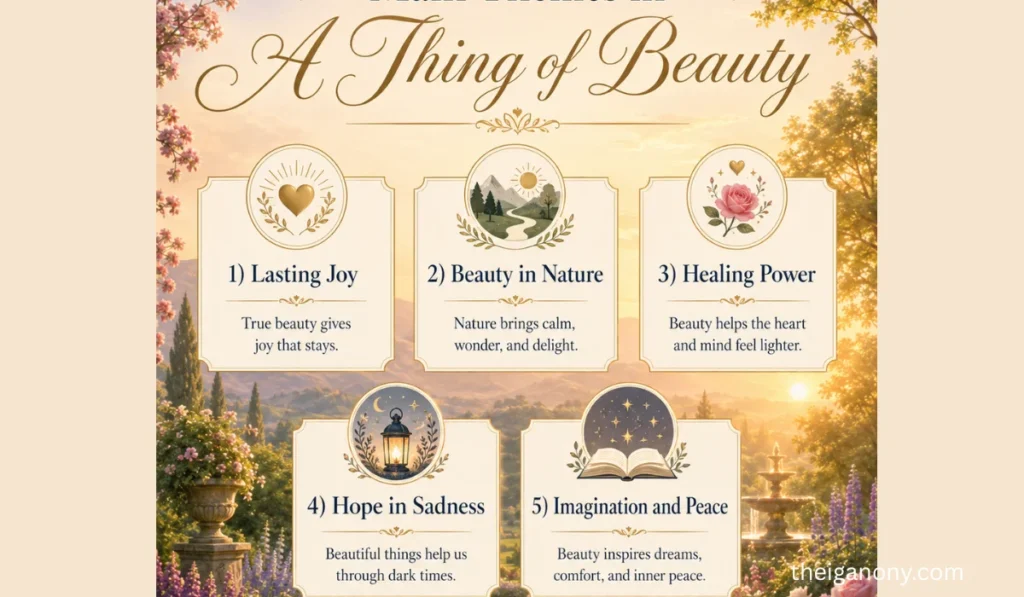
Keats uses beauty as more than decoration.
He shows it as a deep need in human life.
One main theme is lasting joy.
True beauty stays alive in memory even after the moment passes.
Another theme is nature’s healing power.
Trees, flowers, rivers, and sunshine can calm a tired mind.
The poem also shows hope during pain.
Beauty helps people move through dark days with more strength.
Literary Importance
The phrase a thing of beauty became one of the most loved lines in poetry.
It shows the heart of Romantic writing in a clear way.
Romantic poetry often values emotion over cold reason.
It also respects nature, imagination, and personal feeling.
Keats used rich images to make readers feel beauty.
He did not only explain it; he made readers experience it.
That is why his line still appears in essays, speeches, and quotes.
It has become part of everyday English.
Modern Meaning in 2026
In 2026, people use this phrase in many ways.
They use it for art, fashion, travel, home design, and social media posts.
A person may call a sunset a thing of beauty.
Someone may use it for a clean website, a good song, or a perfect goal.
The phrase also works well in captions and blog titles.
It gives a soft, classy, and thoughtful feeling.
Modern life moves fast, but people still need beauty.
This phrase reminds us to slow down and notice good things.
Examples of Beauty in Daily Life
Beauty appears in simple moments.
A mother’s smile, a quiet street, or a clean room can feel beautiful.
A good book can also bring beauty into life.
It can give new thoughts and help the reader feel less alone.
Music can turn a hard day into a peaceful one.
A kind message can also become beautiful because it brings comfort.
So, beauty does not always need money or fame.
Many times, it lives in small and honest things.
Read more: Shaheen bhatt age
Is A Thing of Beauty About a Person?
The phrase is not about one person only.
It can describe a person, place, object, action, or idea.
For example, a kind person can be called beautiful.
Their beauty comes from their nature, not just their face.
A painting can be beautiful because of color and skill.
A poem can be beautiful because it touches the heart.
So, the phrase has a wide meaning.
It can fit many areas of life and writing.
Net Worth, Relationship, and Social Links
This topic does not have net worth, family, or social links.
It is a phrase from poetry, not a living person or celebrity.
But John Keats has literary value that money cannot measure.
His poems still inspire schools, writers, and readers worldwide.
He also had a famous love story with Fanny Brawne.
Their relationship became an important part of his life story.
Keats lived before modern social media.
So, he had no Instagram, Facebook, YouTube, or X account.
Physical Appearance of John Keats
Writers from his time described Keats as short and strong-looking.
He had brown hair, bright eyes, and a serious face.
His appearance matters less than his work.
His words made him remembered across generations.
| Feature | Detail |
| Full name | John Keats |
| Born | October 31, 1795 |
| Died | February 23, 1821 |
| Age at death | 25 years |
| Hair | Brown |
| Known for | Romantic poetry |
| Famous line | “A thing of beauty is a joy for ever” |
Why Students Study This Phrase
Students study this phrase because it has a clear message.
It teaches that beauty can bring peace to the human soul.
The line also helps students understand Romantic poetry.
It shows how poets used nature and feelings to explain life.
Teachers often use it to discuss imagery and theme.
It also helps students learn how one line can carry deep meaning.
The phrase a thing of beauty remains useful for exams and essays.
It gives students a simple way to explain Keats’s view of beauty
Frequently Asked Questions
What is the meaning of a thing of beauty?
It means something that gives lasting joy and peace.
It can be a person, place, object, action, or memory.
Who wrote the line a thing of beauty is a joy forever?
John Keats wrote this famous line.
It appears at the start of his poem Endymion.
Why is the phrase still famous in 2026?
The phrase is still famous because its message feels timeless.
People still need beauty, hope, and peace in daily life
Yes, you can use it in captions, blogs, speeches, and essays.
It works well for art, nature, fashion, travel, and emotional posts.
Conclusion
A thing of beauty is more than a pretty phrase.
It is a strong idea about joy, peace, and the power of beauty.
John Keats made the phrase famous through Endymion.
His message still speaks to readers in 2026.
The phrase teaches us to notice beauty in simple things.
A flower, a kind act, a poem, or a memory can lift the heart.